The Room Is the First Facilitator: Designing Consultation Spaces That Say 'Stay'
There's a particular smell to a certain kind of consultation room. Floor polish, faintly damp carpet, and the ghost of a hundred lukewarm teas. The chairs are stacked against the wall in a way that suggests optimism, or maybe threat. A laminated sign on the door says COMMUNITY ENGAGEMENT — 6PM in Comic Sans. You are here to be heard. Please sign in.
We spend a lot of time in the charity sector thinking about facilitation technique. We train people in trauma-informed practice, we agonise over question design, we buy the good Post-its. And then we hold the whole thing in a room that quietly tells everyone to keep their coat on.
This isn't about fancy interiors. It's about the fact that the physical setup of a consultation event is a brand decision — probably the most honest one your organisation makes that day. Before a single word is spoken, the room is already communicating who belongs, who is welcome, and whether it's worth staying.
Chairs are a sentence
Think about the last time you walked into a room and immediately felt you'd arrived at the wrong party. Nine times out of ten, it was the seating.
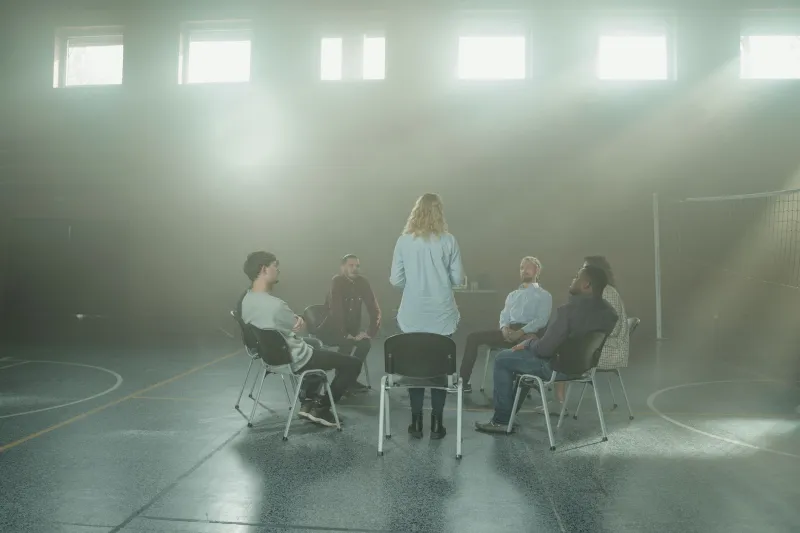
Rows facing a front table say listen to us. A circle says we're all in this. A circle that's slightly too wide says we ran out of chairs and hope you don't notice. And a scatter of chairs around small tables — the default of every village hall from Cornwall to Cumbria — says we've done this before and we're not sure it worked.
There's no single right layout. But there is a wrong instinct, which is to arrange the room for the convenience of the people running it. The facilitator needs a clear sightline; the note-taker needs a surface; the senior manager needs somewhere to put their coat. All fair. But if the layout only solves for the front of the room, the people at the back will solve for themselves by leaving at the break.
Try this: set up for conversation, not presentation. Small clusters of four or five, with enough space to turn a chair without scraping. Keep a clear path to the exit — not because you expect people to flee, but because knowing they can makes it easier to stay. And if you're expecting wheelchairs, buggies, or guide dogs, don't guess. Measure the gaps. A room that technically complies but practically squeezes is still a room that says we didn't really picture you here.
Signage that doesn't shout
Charity signage has a habit of being either invisible or apologetic. A4 sheets Blu-Tacked at knee height. Arrows printed in 9pt. A welcome desk with no one behind it and a sign saying PLEASE WAIT TO BE SEEN, which is the exact phrase used in job centres and minor injuries units.
Good signage does two things: it confirms you're in the right place, and it lowers the temperature. That means large, plain text. It means a sign at the street door, not just the fire door at the end of a corridor. It means writing Welcome — come in, the kettle's on rather than REGISTRATION. It means putting the accessible entrance on the main sign, not in a footnote.
And it means having a person. Not a clipboard. A person. Someone whose only job for the first twenty minutes is to look up, smile, and say hello. In our experience, the greeter is the single highest-return design decision in the whole room. They can explain where the toilets are, take a coat, clock the person hovering by the door, and quietly sort out the chair that's blocking the aisle. No amount of beautiful wayfinding does that.
Light, heat, and the biscuit economy
We could write a whole separate piece about room temperature, but here's the short version: cold rooms make people leave. So do rooms lit like a police interview. If the overhead fluorescents are buzzing, ask if you can turn half of them off and bring in a couple of lamps. If the heating is on a timer that clicks off at 7pm, find out before the event, not during it.
Refreshments are not a nice-to-have. They're a signal. A proper kettle, a cafetière, a plate of something that isn't a wrapped biscuit from a multipack — these say we thought about you as a guest, not a data point. They also create the loose, informal moments where the real conversations happen. The best co-design work rarely happens in the plenary. It happens by the urn.
One practical note: offer something that doesn't require a queue. If everyone has to file past one small table to get a drink, you've built a bottleneck and a hierarchy. Spread it out. Put the good biscuits on both ends.
Who's at the door
The person who greets people sets the tone for everything that follows. If it's the most junior member of staff, standing awkwardly with a sign-in sheet, the room says we didn't think this through. If it's the chief executive, the room says this matters — but only if they then stay and listen, rather than doing a five-minute speech and leaving.
The sweet spot is usually a mix. Someone warm and confident on the door. Someone who knows the building. And at least one person from the project who can answer a question without saying I'll have to check.
Also — and this is the bit people skip — brief the greeter. Give them a one-page script that covers the practical stuff: where to hang coats, when the break is, whether there's a quiet room, what to do if someone arrives upset. That's not bureaucracy. That's hospitality, written down.
A ten-minute room audit
Before your next consultation, stand in the doorway and ask:
- Can I see where to go from here?
- Is there a person, not a sign, to welcome me?
- Can someone using a wheelchair turn around in the main space?
- Are the chairs arranged for talking, not listening?
- Is there a clear, unblocked route to the exit?
- Would I want to stay for an hour in this temperature?
- Is there a drink I can get without queuing?
- Does anything on the walls say something a nervous person would find reassuring?
That's it. No budget required. No rebrand. Just a room that behaves as if people are guests rather than appointments.
Because the truth is, by the time the facilitator opens their mouth, most of the work has already been done. The room has said its piece. Our job is to make sure it's saying something worth hearing.