Nobody Wants to Be a Poster Child: A Dignity Brief for UK Food Banks
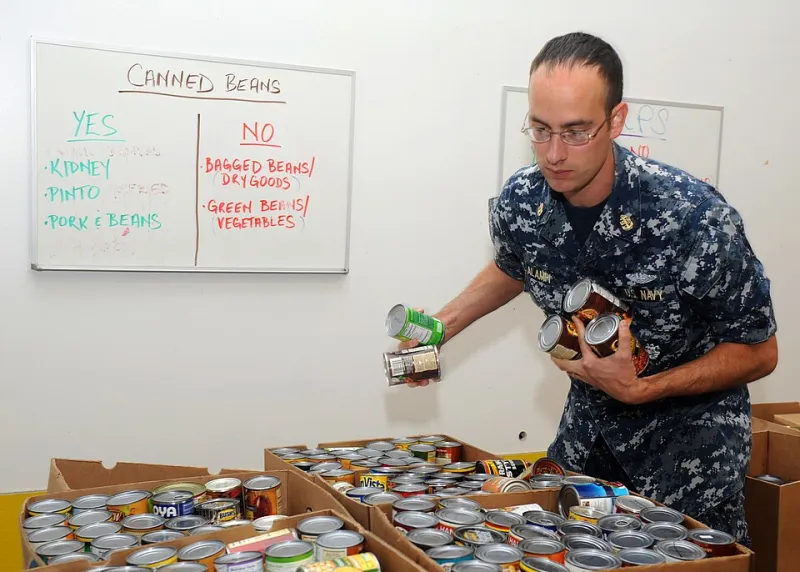
Photo: Petty Officer 3rd Class Kyle Carlstrom, Public domain, via Wikimedia Commons
Dignity is mostly logistics plus attention. That's an unglamorous sentence, but it happens to be true, and it's the most useful thing I can offer anyone designing for a food bank.
Because the big decisions — whether someone needs food, whether there's food to give — are made well upstream of us. What sits in our hands is the hour around it. The walk up to the door. The sign by the entrance. The first thing a volunteer says. Whether there's somewhere to sit. Whether the wall behind the table has a photograph of a child with an empty bowl on it.
Small decisions. Social weight.
The bit before the bag
Most food bank journeys start on a street. Outside a church hall, a community centre, a portacabin. If the queue forms outdoors, you've designed a public declaration of need into the service — visible to the bus stop, the school run, the neighbour walking past. Some people will turn round rather than join it. That's not a lack of need. It's a design failure.
Options are rarely expensive. Staggered collection windows. An indoor waiting area with chairs. A separate arrival door from the one the toddler group uses. Appointment slots for people who'd rather not queue at all, balanced against the fact that people in crisis often can't plan Thursday.
And at the door: never ask 'are you here for the food bank?' across a busy hall. A quiet sign, a folded card, a nod from someone briefed to read it.
Poverty-porn is a brand decision
We've all seen the imagery. The hand reaching into an empty cupboard. The grey filter. The child photographed from behind, because that's somehow meant to be respectful.
Ask yourself the only question that matters: would you use this photograph of your own neighbour without asking? If not, it's not a communications strategy, it's a mood board built out of other people's worst week.
What works instead: photographs of the room, not the people. A full shelf. A kettle. The actual volunteers, with consent, looking like themselves rather than like saints. Quotes from people who chose to give them, in their own words, read back and approved. Nobody owes you a story, and the ones who offer one are owed a fair bit in return — a look at the draft, a say in the crop, a fee or a voucher if it's doing fundraising work.
And funders need to hear this too. If the grant application rewards a sadder image, say so in the application. Several funders have moved; the rest can be nudged.
Queue flow is a dignity question
Where do people stand? Who can see them? How long are they in the room before anyone speaks to them? Is there a chair? Somewhere to put a coat and a buggy? A toilet?
Walk it as a first-timer: arrive, find the entrance, work out where to go, work out who to speak to, work out what happens next. Every one of those steps is a place where someone quietly gives up.
Language, plainly
Pick one word and use it consistently — guest, member, visitor, neighbour. 'Client' sounds like a case file. Avoid 'the vulnerable', 'the needy', 'feeding the hungry', and any sentence where people appear as a category rather than as people.
Then read your own signage as someone who's never done this. 'Referral', 'voucher', 'excess stock', 'trussell' — all of it means something to you and nothing to a person at the door. Add a second line that explains it, every time.
Give the conversation a room
This is the one I'd spend money on first. Not a corridor, not the corner of a busy hall. A small room with a door that closes, two chairs at the same height, a screen or a plant, a kettle. That's where housing gets mentioned, where benefits get checked, where someone discloses something they haven't said out loud yet.
If a conversation needs privacy and there's nowhere to have it, the conversation doesn't happen — and it doesn't come back next week either.
Volunteers are the interface
Your volunteers are the brand, in the way a reception desk is the brand. Brief them properly:
- Greet first. Don't interrogate.
- Never ask why.
- Don't comment on what's in the bag, how much, or what they've chosen.
- Know the three things the service can help with, and the three it can refer on.
- Permission to be warm, and a manager to back them up when warmth meets a rule.
Consistency of welcome matters more than the perfection of the leaflet.
Test it from the visitor's side of the table
Sit where they sit. Time the journey from the door to the first word. Look at the wall behind the volunteer's head — what's on it, and who chose it. Ask three people who've used the service, and pay them for their time. Send a colleague through as a mystery visitor, if the service allows it.
You'll find the friction in an afternoon. Most of it costs nothing to fix.
The dignity brief, in short
- No queue on the pavement if you can help it.
- A quiet way to announce yourself at the door.
- No images of people's need without their say.
- Plain words, explained twice.
- One small room with a closing door.
- Volunteers briefed to greet, not assess.
- A paid review from people who've been through it.
None of this requires a rebrand. It requires somebody to sit on the other side of the table for an hour and notice what it feels like.